2011/01/19
Hansen: "...implying the possibility of multi-meter sea level rise this century."
A draft of a paper by Hansen et al just out today..
Paleoclimate Implications for Human-Made Climate Change
James E. Hansen and Makiko Sato, January 2011
http://www.columbia.edu/~jeh1/mailings/2011/20110118_MilankovicPaper.pdf
Abstract:
"... Deglaciation, disintegration of ice sheets, is nonlinear, spurred by amplifying feedbacks. If warming reaches a level that forces deglaciation, the rate of sea level rise will depend on the doubling time for ice sheet mass loss. Gravity satellite data, although too brief to be conclusive, are consistent with a doubling time of 10 years or less, implying the possibility of multi-meter sea level rise this century. "
As I was saying...!
2011/01/11
It is a moral issue.
In response to a post in Hot-topic.co.nz I suggested that the solution to the present issues confronting us can best be addressed by moral force:-
"Erentz; I most respectfully but strongly disagree with your contention that government is a necessary element in the process of advancing the change required.
I see the issue as a moral issue, not one that 'government' can or even needs to get involved in.
We are told repeatedly by 'government' that the market can lead to change in the products and systems we have to use; carbon-free transport for example. If that is the case, (and it has been for a while) then we-the-market can choose to force those changes.
For example I suggested at a City Council hearing that the most effective thing our city could do to reduce food miles and non-recyclable packaging would be to include a dozen sheets of small stickers which read "I didn't buy this product today because it came from too far away!" and "I didn't buy this product today because the packaging is not sustainably produced or recyclable!". Include these with every notice to householders for a year for them to take with them shopping and the change would be remarkable. They saw the threat to their commercial rates-base however, and demurred.
The moral issue here is well known to most of us:-
It is wrong to keep on doing what we are doing to the Earth. It is wrong because it is having an impact on all of us today, and the impacts on our children and future generations are certain to be worse than we can imagine. Therefore the moral issue relates to the choice between business-as-usual and some other thing.
We do not need government to make these choices, and we do not need government to make these choices known to the market or to any powers-that-be who may have any useful interest in our choices.
The greatest issues of our times have not been solved by government cooperation or action, but by moral action declared by conscious non-violent actions as evidence of the moral stand. The two great examples of the use of moral force are South Africa's abandonment of apartheid and India's freedom from the British. Neither of these remarkable events required the 'cooperation' of governments, but rather the governments fell beneath the force of the moral onslaught.
These shining lights contrast markedly with every other 'solution' that has been tried; with perhaps the notable exception of the elimination of CFCs in relation to the ozone layer depletion - which was achieved cooperatively because (again) the problem and solution were clear and morally it was the morally right thing to do.
There is no other practical way forwards for us;
*We must resolve and declare the nature of the moral issue in terms that the poorest most uneducated and disadvantaged members of our society can grasp, see the rightness of and act on;
*We must apply our individual moral force to the issue by 'becoming the change you want to see in the World' (MKG). If this change is seen as good, then it will encourage others to the rightness of the need for change.
*We must, if need-be, apply non-violent means, including civil non-cooperation against established institutions which are obstacles to the required change to achieve the morally correct end.
That is the only way to take this matter beyond individuals and get the movement that is necessary."
Thanks,
Nigel
2011/01/09
Another perspective - Arctic Ice Gone for Good by 2040?
This from October 2010 - a rather more scientific approach than mine earlier.
A few days ago I used a combination of Arctic sea ice volume data from the University of Washington’s PIOMAS model and NSIDC sea ice extent numbers to project that the Arctic Ocean would be effectively ice-free in late summer within ten years. The key to that exercise was the rate at which the volume of sea ice has been declining ...
by GARETH on OCTOBER 18, 2010
http://hot-topic.co.nz/gone-for-good-arctic-ocean-ice-free-all-year-by-the-2040s/
As I was saying...
Greenland - a turning point by around 2040.
http://beforeitsnews.com/story/346/855/Greenland_s_melting_seems_unstoppable.html
Berlingske Tidende
Friday 7 January 2011, 03:53
'Even if we turned off all power stations and threw the keys to our car away, we would probably be unable to put a stop to it.
'No matter how much we turn down the CO2-burner, Greenland will still reach a significantturning point by around 2040, writes Berlingske Tidende.
'Subsequently, the melting of the island's enormous quantities of ice will continue and continue and in principle not stop until most of the ice is gone.
"It is a very troubling result, because it shows that the melting can go much stronger than we usually imagine," says one of the article's authors, Jens Hesselberg Christensen,Berlingske Tidende.
'...A total meltdown of the ice cap will have the world's oceans to rise with six to seven meters.
2040. Say no more!
2011/01/01
Running Hot and Cold
The recent extreme cold events in Europe have understandably given some folk cause to mutter about the supposed direction of climate change and global temperatures.
But we can be assured that we are on track to our ultimate destination; plus more degrees C than normal civilised life can sustain.
Hansen sums it up thus:
Other recent research has attributed the same sea ice effect on the location of the jet streams, and this is found to be a primary cause of the European winter chills.
"It is nevertheless no contradiction between a global warming and cold winters in regions like Europe. Rather, recent analysis suggest that the global mean temperature is marching towards higher values (see figure below), and Petoukhov and Semenov argue that the cold winter should be an expected consequence of a global warming..." (Rasmus Benestad 20101214)
Running totals of sea ice cover are found at:
http://arctic.atmos.uiuc.edu/cryosphere/
in particular the long term record:
http://arctic.atmos.uiuc.edu/cryosphere/IMAGES/sea.ice.anomaly.timeseries.jpg
From the time series there is evidence of a steady (and increasingly rapid) decline in seasonal ice cover. The Cryosphere charts show that the minimum ice area has fallen from typical historic lows of about 5 million square kilometres to around three million.
But that is only part of the story. The surface of your glass of freshly made lemonade can be covered in ice if that ice is only a thin veneer or if it extends all the way to be bottom to be mashed and swizzled with your straw.
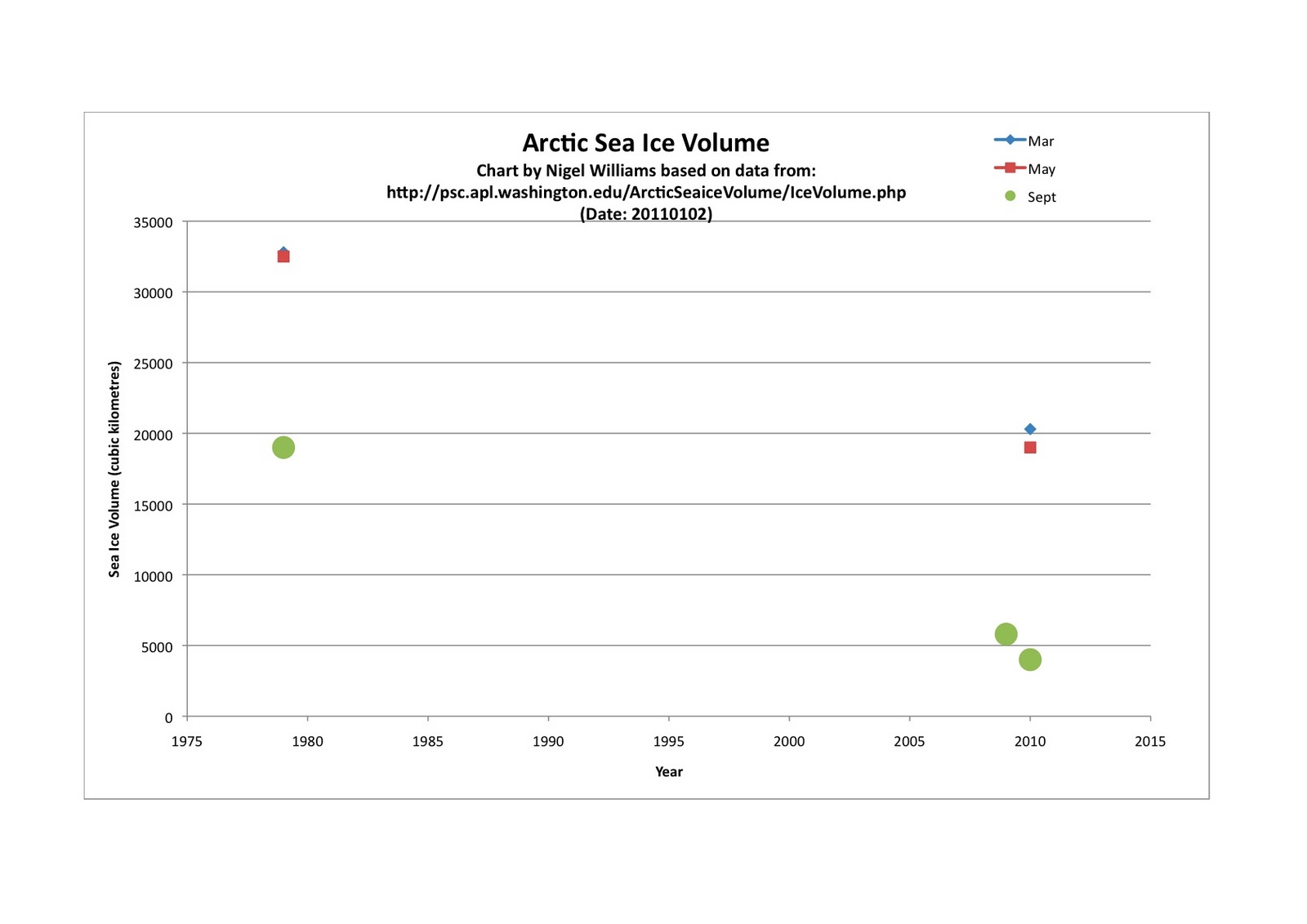
The volume of the sea ice is the key indicator of how things are going. The volume of Arctic sea ice figure is calculated every few weeks by the University of Washington's Polar Science Centre.
http://psc.apl.washington.edu/ArcticSeaiceVolume/IceVolume.php
But while this shows the anomaly (the variance from a running trend) it does not give us a real clue about how much ice volume remains.
From the text and chart on the Washington U Ice Volume site I have extracted a few salient points which as far as I can tell give a true indication of how much ice is left in the Arctic glass.
From this we can see that the summer minimum ice volume has diminished from the 1979 September minimum of 19,000 cubic kilometres to the 2010 September minimum of 4000 cubic kilometres.
I have not joined the dots with a curve, as its non-linear, and the site does not give me enough data to confidently make those interpolations. But the points for 1979, 2009 and 2010 provide sufficient evidence for us to see that, while sea ice cover is still remaining fairly high, the actual volume of ice beneath that cover is declining drastically. The ice on your glass is getting very thin indeed. A layman could be forgiven for drawing the conclusion that an ice-free arctic is not many seasons away.
With that ice goes an enormous heat sink and stabilising influence on the rate of global temperature rise, which will further hasten the rate of loss of grounded ice, and the consequent rate of sea level rise.
If we think back now to the present anomalous state of Europe's recent summer and winter weather with a very modest loss of Arctic sea ice cover, we can only begin to appreciate what may be in store when that last fragile 4000 cubic kilometres of Arctic ice turns to mush not many summers from now, and the lid comes off the Arctic Ocean Weather Machine.
Keep thinking. Keep acting.
Kind regards
Nigel
But we can be assured that we are on track to our ultimate destination; plus more degrees C than normal civilised life can sustain.
Hansen sums it up thus:
"...Sea ice insulates the atmosphere from ocean water warmth, allowing surface air to achieve temperatures much lower than that of the ocean. It is for this reason that some of the largest positive temperature anomalies on the planet occur in the Arctic Ocean as sea ice area has decreased in recent years.
The cold anomaly in Northern Europe in November has continued and strengthened in the first half of December. Combined with the unusual cold winter of 2009-2010 in Northern Hemisphere mid-latitudes, this regional cold spell has caused widespread commentary that global warming has ended. That is hardly the case. On the contrary, globally November 2010 is the warmest November in the GISS record...." (Hansen et al 20101211)
http://www.columbia.edu/~jeh1/mailings/2010/20101211_TemperatureAndEurope.pdfOther recent research has attributed the same sea ice effect on the location of the jet streams, and this is found to be a primary cause of the European winter chills.
"It is nevertheless no contradiction between a global warming and cold winters in regions like Europe. Rather, recent analysis suggest that the global mean temperature is marching towards higher values (see figure below), and Petoukhov and Semenov argue that the cold winter should be an expected consequence of a global warming..." (Rasmus Benestad 20101214)
http://www.realclimate.org/index.php/archives/2010/12/cold-winter-in-a-world-of-warming/
Both commentaries note the potential importance of Arctic sea ice cover.Running totals of sea ice cover are found at:
http://arctic.atmos.uiuc.edu/cryosphere/
in particular the long term record:
http://arctic.atmos.uiuc.edu/cryosphere/IMAGES/sea.ice.anomaly.timeseries.jpg
From the time series there is evidence of a steady (and increasingly rapid) decline in seasonal ice cover. The Cryosphere charts show that the minimum ice area has fallen from typical historic lows of about 5 million square kilometres to around three million.
But that is only part of the story. The surface of your glass of freshly made lemonade can be covered in ice if that ice is only a thin veneer or if it extends all the way to be bottom to be mashed and swizzled with your straw.
The volume of the sea ice is the key indicator of how things are going. The volume of Arctic sea ice figure is calculated every few weeks by the University of Washington's Polar Science Centre.
http://psc.apl.washington.edu/ArcticSeaiceVolume/IceVolume.php
But while this shows the anomaly (the variance from a running trend) it does not give us a real clue about how much ice volume remains.
The site comments:
"Monthly average Arctic Ice Volume for Sept 2010 was 4,000 km^3, the lowest over the 1979-2010 period, 78% below the 1979 maximum and 9,400 km^3 or 70% below its mean for the 1979-2009 period. "
From the text and chart on the Washington U Ice Volume site I have extracted a few salient points which as far as I can tell give a true indication of how much ice is left in the Arctic glass.
From this we can see that the summer minimum ice volume has diminished from the 1979 September minimum of 19,000 cubic kilometres to the 2010 September minimum of 4000 cubic kilometres.
I have not joined the dots with a curve, as its non-linear, and the site does not give me enough data to confidently make those interpolations. But the points for 1979, 2009 and 2010 provide sufficient evidence for us to see that, while sea ice cover is still remaining fairly high, the actual volume of ice beneath that cover is declining drastically. The ice on your glass is getting very thin indeed. A layman could be forgiven for drawing the conclusion that an ice-free arctic is not many seasons away.
With that ice goes an enormous heat sink and stabilising influence on the rate of global temperature rise, which will further hasten the rate of loss of grounded ice, and the consequent rate of sea level rise.
If we think back now to the present anomalous state of Europe's recent summer and winter weather with a very modest loss of Arctic sea ice cover, we can only begin to appreciate what may be in store when that last fragile 4000 cubic kilometres of Arctic ice turns to mush not many summers from now, and the lid comes off the Arctic Ocean Weather Machine.
Keep thinking. Keep acting.
Kind regards
Nigel
2010/11/22
The Price of Change - This just out from Dr James Hansen
The Price of Change
James E Hansen
http://www.columbia.edu/~jeh1/mailings/2010/20101122_ChinaOpEd.pdf
"Sea level rise is one problem. Carbon dioxide amounts of 400ppm (parts per million), expected in 2016 with current emissions, will cause an eventual sea level rise of about 25 metres. China's land area will shrink rapidly, requiring about 250 million people to move inland.
"How rapidly ice sheets will collapse is uncertain. A sea level rise of one metre every 20 years has occurred in the past ice sheet disintegrations. But the human-made climate forcing is far greater and faster than past natural forcings. Ice shelves - tongues of ice protruding into the ocean and buttressing the great Antarctic and Greenland ice sheets - are melting. Both ice sheets are now loosing over 100 cubic kilometres of ice each [year]. If mass loss continues to accellerate, ice sheet collapse may begin within decades."
"Governments must recognise this harsh fact: Burning all fossil fuels would increase carbon dioxide to more than 555ppm and create a different planet - a desolate, ice-free planet with sea levels 75 metres higher than today.
---
Subscribe to:
Posts (Atom)